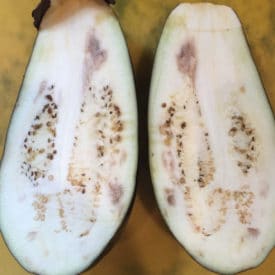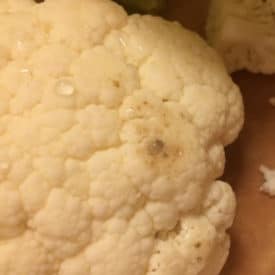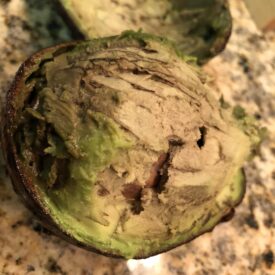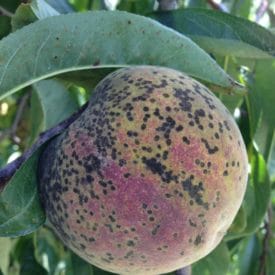
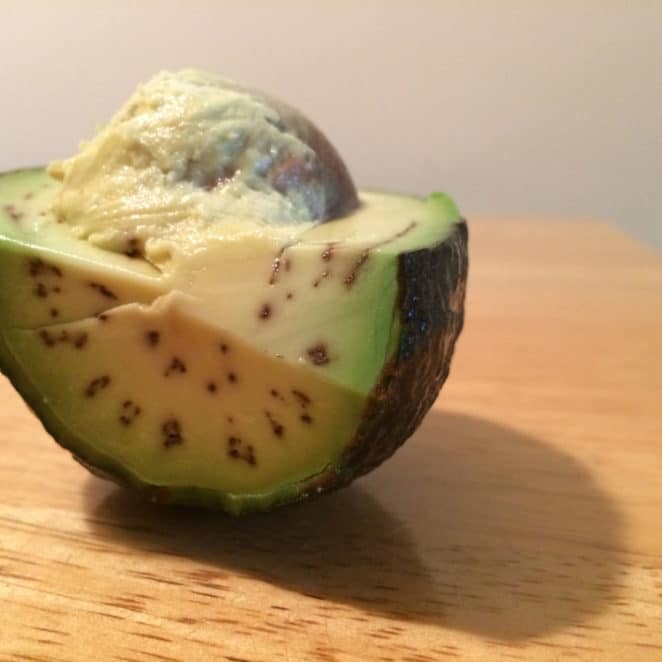
What you see: Brown and black streaks or dots in avocado flesh.
What it is: Vascular browning! Mmmm!
Eat or toss? The avocado could be fine, but may not taste as good. If the spots are relatively mild (and brown, rather than black), give it a taste test before deciding whether to eat it.
What are brown dots and lines in avocados?
The inside of an avocado is a busy place, where nutrients, water and sugars are ferried around. Normally their “transport channels” are invisible to us. Unless, of course, something goes wrong.
In the case pictured above, the avocado’s internal thoroughfares (known as “vascular tissue”) may have been ravaged by too-cold storage for too long. The cells that make up that tissue weakened and started dying.
So that vascular tissue turned brown, which highlighted the avocado highways as lines when the avocado is cut along its long axis, and little dots when it’s cut through its fat middle. (The image below is a long axis cut through the same avocado as the one at the top of this post.)
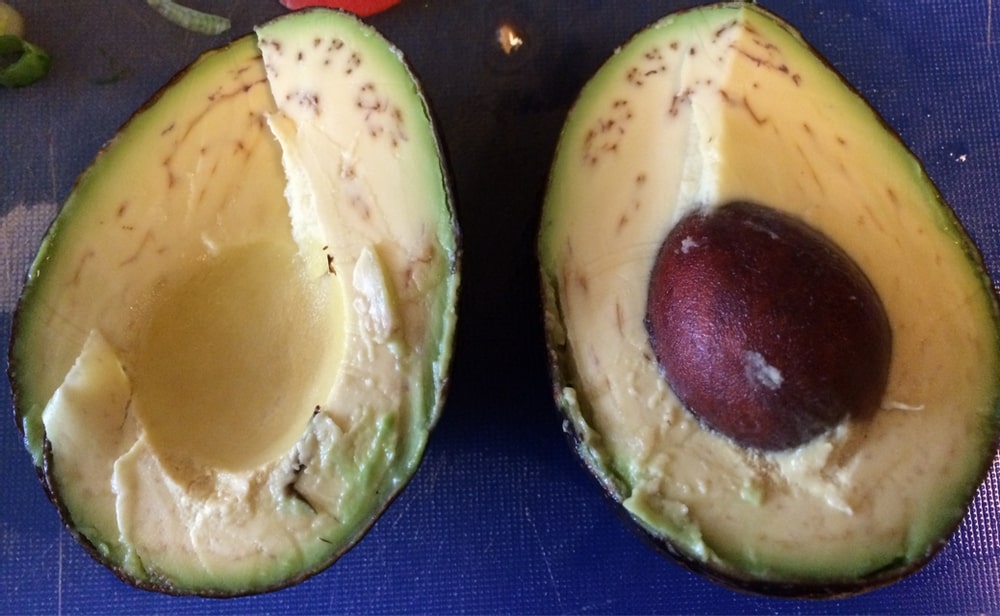
Elhadi M. Yahia, a professor at the Autonomous University of Querétaro in Mexico who has studied avocado handling after harvest, said a few weeks of refrigeration, likely before you even purchased your avocado, could lead to such vascular browning. Avocados, as fruits that are accustomed to warmer weather, simply don’t do well in the cold.
The disorder typically becomes visually apparent after the fruit has ripened at room temperature for a couple days.
Is it OK to eat an avocado with brown dots or brown lines?
“I have absolutely no problem eating them,” Yahia said of the little brown pathways, with the caveat that palatability will depend on severity.
The issue worsens—and creates icky flavor changes—with time. Eventually you’ll find blackened tissue and rancid flavors as the avocado’s fats and enzymes react with oxygen in not-so-tasty ways.
When cold temperatures cause vascular browning, the issue starts in the center of the fruit, Yahia said. It’s also possible for fungi to enter the fruit from the vulnerable spot where the stem attaches and travel along the vascular tissue in something called “stem-end rot.”
While vascular browning doesn’t necessarily indicate an infection, when cells weaken and die, they also become more vulnerable to decay organisms.
But Yahia said that the fungi that tend to strike avocados are not known to be harmful to humans and he was not aware of any food safety issues connected to vascular browning. If things are really going south, you’ll probably taste or smell a problem and won’t want to eat the fruit. That would be a rotten avocado.
Where does the brown color come from?
The short answer is oxidation. Here’s the more interesting (I think!) long story, which includes a chain of chemical reactions:
When an avocado is injured, whether it’s bruised from a fall or sliced open with a knife, or being stored in an environment so cold its internal machinery misfires, the affected cells often break open or leak. This causes things normally kept separately (specifically phenolic compounds bundled in vacuoles in the cells and an enzyme, polyphenol oxidase, which is often floating freely in the cell’s cytoplasm) to mix. When the phenolic compounds interact with the enzyme and oxygen they produce compounds called quinones, which can be toxic to any invading microbes. Those quinones then react with other compounds to form a type of melanin. You’re probably familiar with melanin as the pigment that colors our skin and hair–it also can appear in a range of brown and black shades on injured produce like apples, mushrooms, and even shrimp.
According to Britannica, avocados go brown extra fast because they have high concentrations of the enzyme that causes green flesh to go brown.
Can you prevent little brown spots and dark streaks from forming in avocados?
Yes and no. Often the cold storage can happen while the avocado is in transit from the farm to the grocery display. In that case, they’re not much you can do (unless you’re a distributor or a grocery store!).
But once you have custody of the avocado yourself, you can store it properly to prevent chilling injury. That means leaving the avocado at room temperature until it’s soft enough to eat (you can tell by squeezing it gently, but don’t press too hard or you could cause another problem!). Then, put ripe avocados in the fridge until you’re ready to use them. While putting underripe avocados in the fridge can cause chilling injury and disrupt the ripening process, the cooler environment will simply keep perfectly ripe avocados fresh for longer. (By the way, the same is true of bananas — underripe bananas go bonkers in the fridge, but once a banana has reached your ideal ripeness, it will last longer if keep cool. But, be warned — it’s peel will turn black in the process, even as the flesh stays perfectly ripe.)
Are brown or black areas in avocados ever mold?
Various microorganisms can wreak havoc in avocados, either entering through the “button” at the top or through a weakened area of the peel. Fungi work in different ways, but they may make the flesh look slightly gelatinous, and create brown large brown spots or lesions on the soft green surface. While a microbial invader can travel along vascular channels, it’s common to see the rot work its way from the outside in. The skin just under the peel may brown and break down first.
While I know I’ve encountered fungal avocados in my kitchen, I rarely see fuzzy mold growth inside an avocado. That said, the International Avocado Quality Manual reports that “in extreme cases” the fungus that causes stem end rot may create “cavities and cotton wool-like fungal growth.”
How do you know when an avocado is rotten?
Simply put, it will look and/or smell and taste terrible. You may see brown and black tissue throughout. Some of the avocado flesh might be unsettling soft and squishy. It may smell bad. For more on rotten avocados, check out this post.
The avocado pictured at the top of this post wasn’t rotten. It was certainly showing its age and demonstrating that it wasn’t handled properly, but it still tasted fine and was OK to eat.
SOURCES:
- Elhadi M. Yahia. Food Science & Post-harvest Handling Professor. Autonomous University of Querétaro, Mexico. Leader of the Phytochemicals and Nutrition Laboratory.
- Avocado: Recommendations for Maintaining Post-Harvest Quality. Adel A. Kader and Mary Lu Arpaia. University of California.
- The Avocado: Botany, Production, and Uses. Edited by A. W. Whiley, B. Schaffer, B. N. Wolstenholme. 2002. P. 368.
- Hot Water Drenching of ‘Hass’ Avocados for Rot Control. MSc Thesis by Emma Terander. Horticulture Program. Institute for Plant Science. Alnarp Sweden.
- Avocado Post-harvest Operations – Post-harvest Compendium. Food and Agriculture Organization of the United Nations.
- Maturity effects on avocado postharvest physiology in fruits produced under cool environmental conditions. J. G. M. Cutting and B. N. Wolstenholme. Department of Horticultural Science, University of Natal.South Africa. South African Avocado Growers’ Association Yearbook 1991.
- G. Hopkirk , A. White , D. J. Beever & S. K. Forbes (1994) Influence of postharvest temperatures and the rate of fruit ripening on internal postharvest rots and disorders of New Zealand ‘Hass’ avocado fruit, New Zealand Journal of Crop and Horticultural Science, 22:3.
- Plant Development I: Tissue differentiation and function. Biology 1520. Georgia Tech Biological Sciences.
- Discover the health benefits of avocados and learn how to cut, peel, and prepare avocados for maximum health benefit and how to keep guacamole from browning. Britannica.
- HOW PLANTS DEFEND THEMSELVES AGAINST PATHOGENS. GEORGE N. AGRIOS, in Plant Pathology (Fifth Edition), 2005. Chapter 6.
- Fruits Gone Bad? Discover Enzymatic Browning: A color-changing science project from Science Buddies. Science Buddies, Svenja Lohner. Scientific American. April 11, 2019
Updated January 2024