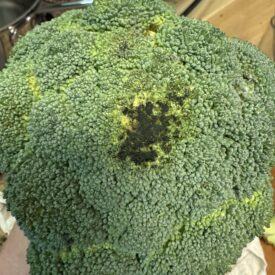

What you see: Your broccoli head is turning yellow.
What it is: Overall yellowing is a sign of over mature broccoli; the broccoli could have been stored too warm or faced other challenges.
Eat or toss: As long as you don’t see obvious rot, like slimy, squishy areas or mold fuzz, the broccoli is still OK to eat. It may, however, have lost some nutrition.
Can you eat yellow broccoli?
If your broccoli is turning yellow, that’s probably a sign that it’s overmature, has been stored at too-high temperatures and/or that it’s been exposed to problematic levels of ethylene. Ethylene, of course, is a gas plants produce; it triggers ripening and aging.
As long as the head isn’t developing any moldy, slimy, squishy or odorous patches (all signs of microbial growth), it’s still edible, though yellow broccoli may have lost some nutrition. Vitamin C, for example, dissipates as broccoli ages.
Broccoli ages quickly
All produce respires, as in, it takes in oxygen and expels carbon dioxide to keep its cellular machinery running. The faster a piece of produce respires, the faster it ages and burns through its limited supply of resources (once cut off from the plant, it can no longer rely on the roots and leaves for new influxes of energy, nutrients and minerals). In broccoli, turning yellow is a sign of aging; harvested, aging broccoli, no longer attached to the roots or leaves of the plant, gives up on photosynthesis and breaks the green-hued chlorophyll down into components it can more readily use.
Broccoli is relatively immature tissue—it’s made up of flower buds after all—and so respires at a particularly high rate. This means it goes south quickly. Keeping the veg cool in the fridge dramatically slows respiration, which helps it last longer.
“If you maintain the cold chain, you’re slowing that aging process enough that it just takes a lot longer to get to the yellowing stage,” said Tie Liu, an assistant professor of horticultural sciences at the University of Florida.
Yellow broccoli has lost some nutrition
According to Postharvest Technology of Horticultural Crops, a fresh green appearance is also a good indicator of nutritive value. The book, published by the Agriculture and Natural Resources Department at the University of California, explains, “The rapid changes in chlorophyll are closely associated with the visual symptom of yellowing of the beads (florets)…The vitamin C (ascorbic acid) and carotenoid (about 80% pro vitamin A or betacarotene) concentrations closely follow the changes in chlorophyll concentration.”
I’ve actually never noticed my broccoli turn from green to yellow while it was in my fridge (it typically spoils in other ways first). But, while working on this post, I left some broccoli unrefrigerated on my counter. It turned yellow pretty fast.
If your broccoli is yellow, it’s also possible that it was stored at a too-high temperature before you purchased it, or that it was stored next to another type of fruit or vegetable that release high amounts of ethylene. (But don’t worry about yellow patches just below the surface and between the florets—those are simply areas the sun didn’t reach.)

Broccoli storage tips
Broccoli’s shelf life varies based on the specific variety and how it’s handled, though University of Florida researchers report that, from harvest to plate, it can last about 30 days, as long as the cold chain is kept intact.
Keep broccoli in the fridge, ideally in the crisper, which will help trap humidity, keeping the broccoli firm, but allow for air flow, which will keep it dry (and therefore less inviting to microbes). Try to use it within a week, but you can probably get more time out of it if you need to. Pre-chopped broccoli has a shorter shelf life than intact heads.
SOURCES:
- Tie Liu. Assistant Professor in Horticultural Sciences. University of Florida. Interview. Summer 2024.
- UF scientists finding new way to keep broccoli – and perhaps other vegetables — fresher, longer. Press release. University of Florida. Institute of Food and Agricultural Sciences. May 21, 2024.
- Postharvest Technology of Horticultural Crops. Third Edition. Adel A. Kader. Technical Editor. 2011. University of California Agriculture and Natural Resources Communication Services
- Broccoli. Produce Fact Sheets. Postharvest Research and Extension Center. University of California. Agriculture and Natural Resources.
- Broccoli Brassica oleracea var. Italica. Postharvest Guide to Broccoli. Horticulture Innovation Australia. Western Sydney University.