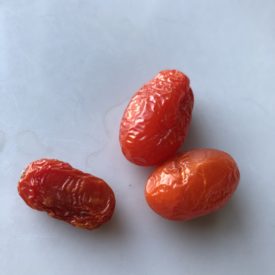

What you see: A wrinkly mango.
What it is: A mango that’s probably both overripe and dehydrated.
Eat or toss: Peel, give it a taste and eat if it tastes good!
Why do mangos get wrinkly and shriveled?
Fruits and vegetables are packed with moisture. It keeps their cells firm and plump and is directly responsible for a crisp apple or a juicy peach. Of course, over time, especially in a dry environment, those same fruits and vegetables lose moisture. And once they’re harvested, they’re no longer connected to the root system that could easily replenish that water. So, as the cell-firming water flees, different produce responds in different ways. A celery stick might go limp while a mango like this develops wrinkles.
Why does the flesh of an overripe mango look “glassy”?
In addition to losing water after harvest, many fruits also soften as they ripen and then soften even more as they move into the post-ripening stage known as “senescence.” That aging leads cells to break down and leak juices into the spaces between the cells. This can make the mango flesh look water-soaked or glassy. Personally, I usually find mango flesh with a glassier look to be extra tasty. And none of these changes mean a mango like this is no longer good to eat. I ate this mango and can confirm that it was absolutely delicious.
An overripe mango contains more alcohol
A mango’s normal ripening process produces alcohol, which we mango eaters detect, not as alcohol, but as simply part of the normal flavor of the mango.
In an overripe mango, there’s more alcohol and often IMHO, more flavor. This is because the mango’s cells have resorted to anaerobic respiration. Up until this point, even as the mango sat in your fruit bowl, the cells have been busy taking in oxygen, releasing carbon dioxide and otherwise running their cellular machinery. But as those cells broke down and leaked with age, they flooded the tiny corridors that oxygen traveled to get to the cells. So, without oxygen, cells went the anaerobic route, creating ethanol as a byproduct. But that bonus ethanol is still unlikely to be enough for us to notice.
“It’s not anything that could get you intoxicated,” said Jeff Brecht, a horticultural sciences professor at the University of Florida. “The amounts we measure are in the parts per million range.”
Older mangos are more vulnerable
When honey mangos/ataulfo mangos like this one get to this early wrinkled stage, I often find them to be perfect. My results are more mixed with more “standard” mango varieties found in the U.S. (those with red and/or green skin), which I find more likely to rot before they wrinkle. In any event, an overripe mango is still an older mango and may also be more likely to have other issues, impacting its quality (internal breakdown, among other indignities). A quick inspection and taste test are always a good idea.