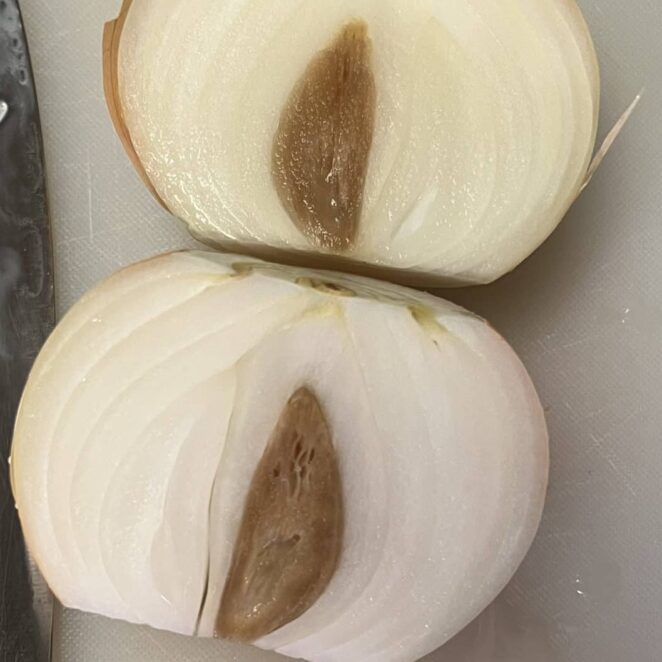
What you see: The center of your onion is brown and squishy.
What it is: Bacteria is breaking down layers of the onion. This condition is called “center rot.”
Eat or toss: Don’t eat the rotten part or the layers touching it. The types of bacteria that cause this rarely sicken people. But those who are immunocompromised may be vulnerable. If only part of the onion is affected, you may be able to salvage the rest — just clean your surfaces and cook thoroughly.
Can you eat an onion that has a brown, rotten center?
If you cut into an onion that has a brown, rotten center, or brown, rotting rings, you’re likely looking at an onion disease called center rot. The squishy areas are essentially portions of onion that have been consumed by bacteria. Obviously, decaying areas will taste terrible and should not be eaten. Here’s how to assess and handle the rest:
- If there’s not much onion left to salvage, or if the rotten portion is extra goopy and will be hard to get off the rest of the onion (if, say, your knife dragged it through otherwise clean areas), you’ll probably want to toss the whole thing. If, however, there are large, unaffected areas, keep going.
- Cut out the rotten areas and the layers touching them. Discard/compost them.
- Rinse off the remaining onion, as well as your knife and cutting board.
- Chop the rest of the onion.
- Cook the rest of the onion.

What causes center rot in an onion?
Various kinds of common bacteria can cause center rot. The bacteria often get into the onion through natural openings or wounds, such as bites from tiny insects. On the onion plant, each narrow above-ground leaf leads to a scale in the onion bulb. That connection enables the infection to travel down the leaf into the bulb. This is why the outside layers of the onion can appear perfectly healthy, even as the center looks terrible. It’s also why, despite its name, center rot sometimes afflicts a ring of the onion, not necessarily the center.

Rain or overhead irrigation can also spread the bacteria, particularly if contaminated water droplets splash onto wounded areas of the plant. Hail or heavy rains that damage their tall, grass-like leaves can also put onions on a fast track to center rot. Of course, the bacteria can also enter through the onion neck, especially when it’s freshly cut, open and vulnerable after harvest.
Can you tell if an onion has center rot from the outside?
Maybe. Center rot onions often look just fine on the outside; consumers usually don’t discover the problem until they’ve cut open the onion. Jeffrey Stoltzfus, an educator with PennState Extension, suggested taking a close look at the onion neck. Any moisture there is a clue that center rot could be lurking.
“It should be paper dry,” said Stoltzfus, who specializes in produce safety on farms. “If there is any moisture at the end, that often is an indication that it’s rotten.”
Can an onion with a brown, rotten center make you sick?
It’s unlikely, but not impossible. First, any food succumbing to microbial rot is a petri dish of who knows what, though usually the greatest consequence is that your food will taste gross. Second, the types of bacteria that rot onions from within are generally known for being plant pathogens, not human pathogens. That said, some of the same bacteria that afflict onions, for example, Pantoea agglomerans, have been implicated in infections in immunocompromised individuals. In humans, P. agglomerans cases tend to involve pneumonia or wound infections, sometimes from thorns on plants, or from contaminated hospital surfaces or fluids. But while this bacteria can cause problems for people, I couldn’t find a single documented case in which handling an infected onion lead to a human infection. And again, infections from these bacteria are rare overall.
For extra reassurance, these bacteria concerns can be allayed by cooking. Make sure your onion reaches 165 degrees Fahrenheit to nix any problematic bacteria. For most healthy people, the primary reason to avoid eating the rotten areas will be to avoid eating something that tastes gross.
My onion developed a rotten ring AFTER I chopped it and put it in the fridge
Stoltzfus noted that even if an onion looks fine after slicing, it’s possible that, after a couple days in the fridge, you might notice a rotten ring. In such a case, the infection may have been in its undetectable, early stages when you first cut into it or the knife may have delivered bacteria to the freshly cut—and therefore more vulnerable—cells. The protocol here would be the same: Remove the rotten area and the layers around it. If enough looks salvageable, cook the rest.
How can center rot be prevented?
Sweet onions tend to be more susceptible than more pungent onion varieties, but aside from selecting more intense onions, there’s not much you can do as a consumer to prevent the occasional inner onion surprise. On the farm, eradicating the disease means walking a fine line between providing the essentials onions need to grow without creating an environment the bacteria will love, Stoltzfus said.
“Certain soil conditions such as warm, wet soil and excessive nitrogen levels can help the bacteria grow,” he explained. “Of course onions need warm, moist soil with adequate levels of nitrogen to grow. So it becomes a balancing act of providing enough of those elements to grow the onions without providing excess to promote the bacteria.”
Stoltfuz noted that farmers navigate this while operating amid forces—like the weather—outside their control. Sometimes, he said, they have to be proactive and take calculated risks to manage or prevent the disease. For example, if a leaf-damaging storm is in the forecast, they’ll know that the odds of the onions coming down with center rot have gone up. So they’ll need to decide between harvesting a little earlier—when the bulbs will be smaller—or harvesting later and risking center rot or another bacterial disease.
“It’s kind of a race,” Stoltzfus said. “Where you look at the weather, you look at the size of the onion and, the growers have to decide, do I let the onion get bigger, or do I harvest it now before it rots?”
Stoltzfus, who has helped farmers reduce their rate of center rot, said it also helps to stop irrigating a week or two before harvest so the onions can dry out. Just after harvest, when onions are particularly vulnerable, he recommends using fans to help any stray moisture quickly dry up.
Farmers can also make sure they’re getting high quality seed and transplants, rotate their crops, avoid overhead irrigation, take steps to reduce thrips (tiny insects that spread the bacteria), harvest onions with clear signs of disease earlier, and leave a taller portion of the onion neck intact when harvesting, according to Penn State researchers.

SOURCES:
- Jeffrey Stoltzfus. Extension Educator. PennState Extension.
- Rotten to the Core: The Center Rot Disease of Onion. Jennie Diehl Mazzone. Beth K. Gugino, Ph.D., Ram Neupane. PennState Extension. Updated April 2024. Accessed August 2026.
- Dutkiewicz J, Mackiewicz B, Kinga Lemieszek M, Golec M, Milanowski J. Pantoea agglomerans: a mysterious bacterium of evil and good. Part III. Deleterious effects: infections of humans, animals and plants. Ann Agric Environ Med. 2016;23(2):197–205.
- Clinical and microbiological characteristics of Pantoea agglomerans infection in children. Ayşe Büyükcam, Özlem Tuncer, Deniz Gür, Banu Sancak, Mehmet Ceyhan, Ali B. Cengiz, Ateş Kara. Journal of Infection and Public Health Volume 11, Issue 3, May–June 2018, Pages 304-309
- Huang L, Price EP, Sarovich DS, et al. Bacteremia and Community-Acquired Pneumonia Caused by Pantoea stewartii Subspecies indologenes, Australia. Emerging Infectious Diseases. 2025;31(2):328-331.