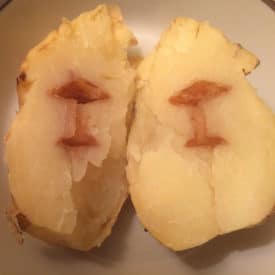

What you see: Your potato looks relatively normal on the outside, but when you cut into it, you discover a dark cavern. When you more closely inspect the exterior, the place where the stem used to attach looks dry, but also a bit rough or corky.
What it is: A microorganism snuck in through an injury where the stem used to attach and is wreaking havoc.
Eat or toss: How severe is it? If it’s not throughout the entire potato, cut around it with one-inch margins and get on with your dinner. If there’s not much to salvage, toss it.
A dark cavern traveling through your potato?
If you see a dark hole developing through the middle of your potato, and you can trace a path from that hole to the exterior of the potato, like in the images here, it’s evidence that something got into your potato and started eating, explained Nora Olsen, a potato specialist at the University of Idaho. Here, a top suspect is “dry rot” in which a fungus sneaks into the potato via an injury and then rots the potato from the inside. You might see light brown, dark brown or black surfaces alongside the “cavern walls” in the potato. Eventually, yellow, white or pink mold could form on those surfaces.
In the examples here, it’s likely that the fungus got in through the spot where the stem used to attach it to the rest of the plant.
Are you seeing a hole that doesn’t connect to the outside of the potato? Check out this post about hollow heart and this post about internal injuries. Find all our potato posts here.
How the potato stem area is vulnerable to fungal infection
While potatoes grow underground, they’re connected to their siblings—and to energy and nutrients from the above-ground part of the plant—via stolons or narrow underground stems. Once a potato is grown up enough to set out on its own and grow a new potato plant, the stolon naturally detaches. This happens via the same mechanism (abscission) that trees use to seamlessly drop their leaves in the fall. When plants deploy abscission, certain cells deliberately die and seal up the area; this enables stems, leaves, petals and other no-longer-needed plant parts to fall away without creating any breaks in the tissue.
But sometimes abscission doesn’t go as planned. A stolon might still be present on the potato when you buy it from your local farmer. Or a stolon might still be green and not yet have abscised when the potato is harvested. Or, a stolon might fail to abscise and then get tangled and torn off during the harvest (which is often automated with large pieces of equipment like this). If a stolon is weakened or injured or if it is torn off or if it otherwise falls off in a way that breaks open cells, opportunistic microbes might creep in.
In cases like the ones pictured here, the fungus does its dirtiest work on the inside of the tuber. So the exterior may seem dry, but if you look closely, you can see that something doesn’t look right at that stem attachment point.


Likely a fungus known as potato dry rot
Dry rot is a scourge of the potato industry. It’s caused by several members of the fungus genus Fusarium and often results in expanding caverns in potatoes, like you see here. True to its name, “dry rot” doesn’t generate ooze and squishy areas like other decay organisms might. It also moves slowly. Dry rot tends to work on the central portions of the potato first, Olsen, explained, because that’s where there’s the most water and the least starch.
“It goes on the path of least resistance,” she said. “It can just rot the potato from the inside out.”
As it hollows out the potato from the inside, it may cause the surface to look sunken.

It’s also possible for a bacterial disease, soft rot, to move in once dry rot has taken hold. In that case you’d also see some squishy areas. Soft rot is more likely if the potatoes are stored in a very humid area; the initial damage by the dry rot, along with condensation, will help the bacteria along.
Can you eat a potato with a cavern like this inside?
We’ve previously written about potatoes that developed inner cavities after injuries that did not break the skin. In those cases, you might notice off flavors, colors and textures, but those would be consequences of chemical and physical reactions that fired when cells were damaged by force. Once a microorganism has taken hold, however, the menu of potential issues expands. You could have more severe off flavors. A fungus, including those implicated in potato dry rot, might produce toxins you don’t want to eat.
In a case like this, I would cut the potato in half to get a sense of how far the infection has spread. If the other half of the potato is fine, I’d still eat it. I’d also try to allow for one-inch margins around the infection, but wouldn’t sweat it if I came a little closer than that. The U.S. Department of Agriculture advises consumers to cut 1-inch margins around any moldy areas to avoid consuming mold toxins in areas that might still look fine. Researchers who have studied toxin spread within potatoes afflicted with a specific type of Fusarium concluded that trimming at least 2 centimeters (.7 inches) around the rotted tissue would account for any spread of toxins into areas of the potato that still look fine.
Any injury can lead to dry rot
While the images in this article suggest that the fungus entered via an injury in the stolon area, any injury that creates an opening can lead to dry rot. Growers can help prevent dry rot by avoiding injuries during harvest and by properly “curing” their potatoes after harvest. During curing, freshly harvested potatoes are stashed in spaces with carefully calibrated, temperatures, humidity and air flow to promote wound healing.
SOURCES:
- Nora Olsen. Professor and Extension Specialist in Potato and Horticulture. University of Idaho.
- Trichothecene Mycotoxins Associated with Potato Dry Rot Caused by Fusarium graminearum Javier A. Delgado, Paul B. Schwarz, James Gillespie, Viviana V. Rivera-Varas, and Gary A. Secor. Phytopathology. 2010 100:3, 290-296. Accessed August 2026.
- Molds on Foods: Are They Dangerous? United States Department of Agriculture. Food Safety and Inspection Service. Last updated August 2013. Accessed August 2026.
- Fusarium Dry Rot of Potato. Originally created by Rosemary Loria for Vegetable MD Online. Updated May 2021 by Margaret Tuttle McGrath. Cornell Vegetables: Resources for Commercial Growers. Cornell College of Agriculture and Life Sciences. Cornell University. Accessed August 2026.
- Tiwari RK, Kumar R, Sharma S, Sagar V, Aggarwal R, Naga KC, Lal MK, Chourasia KN, Kumar D, Kumar M. Potato dry rot disease: current status, pathogenomics and management. 3 Biotech. 2020 Nov;10(11):503. Accessed August 2026.
- Molecular Mechanisms of Abscission in Plants. Nature Index. Springer Nature. Accessed August 2026.
- How Potatoes Grow. North Carolina Potato Association. Accessed August 2026.
- Fusarium dry rot Phillip Wharton, Ray Hammerschmidt and William Kirk (Department of Plant Pathology, Michigan State University.) Michigan Potato Diseases. Michigan Extension Bulletin, May 2007. Accessed August 2026.