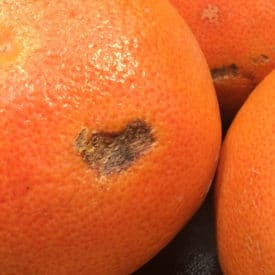

What you see: Brown, irregularly shaped splotches on your grapefruit.
What it is: Most likely, this is simply an old grapefruit. Some of the cells in the peel are dying of old age.
Eat or toss: Eat! This issue is restricted to the peel. A grapefruit that looks like this will likely still taste great, but keep in mind that flavor and quality can fade with time. Give the fruit a taste and go from there.
If you wait too long to eat your grapefruit (or oranges or mandarines etc.), you may find they look like this. There’s nothing unsafe about this grapefruit, but some of its peel cells have collapsed and turned brown.
Mark Ritenour, a professor of postharvest technology at the University of Florida, described it as “general peel breakdown.” Basically, the grapefruit, which has been away from the nutrient-replenishing forces of the tree for quite some time, started running out of the resources it needed to keep its cells running.
“Certain cells in the peel have decided, that’s enough, we’re done,” Ritenour explained.
This doesn’t look like the work of a fungus or bacteria for a number of reasons. First, the grapefruit is still relatively firm and none of it is going squishy. Second, the brown discoloration is throughout the peel, not concentrated in one area and expanding out, as you might see with a spreading disease. Infections from microorganisms often also feature a bullseye type look, with growing rings of afflicted tissue, which clearly isn’t happening here. Finally, there’s obviously no fuzzy mold growth.
Will a grapefruit that looks like this still taste good?
Probably! While some of the peel cells have died, the juicy inner fruit could easily still be fine. With age, however, fruit can lose flavor. So, give it a taste and see what you think.
How should you store grapefruit to extend its life?
The fridge is best! Citrus will run its cellular processes more slowly in a fridge, which means it will conserve its energy and resources better and the cells will chug along for more time, thus keeping it fresh for longer. The fridge will also slow or prevent microbial growth. Take care to store the fruit in a way that discourages condensation or contact with moisture—that will also invite thirsty microbes.
This grapefruit may actually represent the best case scenario in terms of how much life you can get out of your fruit. It was stored in the fridge, where it held on for a while. It evaded microbial growth and when enough time passed, it simply started succumbing to old age.